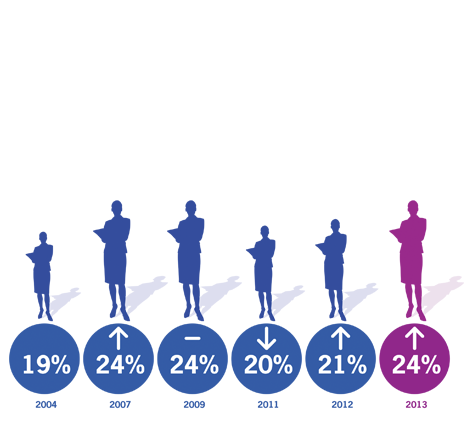
With the growing focus on ESG among corporate stakeholders – including expectations for diverse workforces and an inclusive working culture – organisations need to ensure the ‘G’ in ESG includes diversity and inclusion measurement. Tracking metrics including gender parity will enable businesses to set appropriate goals, manage risk, design effective initiatives, demonstrate D&I successes to stakeholders, and engage their workforces – resulting in better business outcomes.

Over the last 18 months, we have all had cause to be more empathetic, in our home lives, with our colleagues, and towards our communities. And business leaders have faced imperatives to be empathetic in their roles, as physical collaboration has been replaced with virtual interaction, and staff have been placed under unprecedented stresses, calling for an altered, more flexible leadership skillset.
Technology played a critical role in mitigating the impact of the virus. Whether helping employees to perform their jobs or providing a platform for fulfiling products and services, technology enabled new ways of doing business.
Global business is facing a wave of disruptive influences that look set to spark the Fourth Industrial Revolution. We explore how the way professionals work is evolving, the leadership skills that will be needed within the dynamic mid-market to thrive, and how organisations can stay competitive in the war for talent and customers in 2030.
Businesses in the world’s three biggest economies, the United States, China and Japan, are increasingly feeling the heat when it comes to recruiting skilled staff. Given that these countries together represent over a third of global output, a deficit of skilled staff could have a significant knock-on effect on economic growth not just in these economies but beyond.
Crowdsourcing is not a new concept. I see it as the guiding principle underpinning democracy; the wisdom of the crowds pick a better leader than any individual could (we hope!) But what about using crowdsourcing to develop business strategy?
Do leadership styles differ around the world? This is one of the questions explored by our recent International Business Report. We asked 3,400 business leaders working in 45 economies to tell us how important they believe certain attributes are to good leadership.
The real estate and construction sector continues to make steady progress as it recovers from a financial crisis in which investors, developers and homeowners were disproportionately hit.
Poland’s economy avoided recession during the 2009 financial crisis,and rebounded strongly in 2010-2011. Poland: dynamism at the heart of Europe.
Polska gospodarka uniknęła kryzysu finansowego w 2009 roku. Po okresie spowolnienia, w latach 2010-2011 powróciła na ścieżkę wzrostu. Polska nie mogła jednak całkowicie uniknąć skutków globalnego kryzysu. Wymiana z Europą stanowi bowiem ponad 80% całego polskiego handlu zagranicznego. Gospodarka rosła więc wolniej w porównaniu do czasu sprzed kryzysu gospodarczego, osiągając w latach 2012 i 2013 tempo około 1,5% rocznie.
Dynamic businesses at the forefront of M&A activity highlights an increasing importance for M&A in driving growth. There is a clear acknowledgment from the 12,500 businesses surveyed that acquisitions will be needed to supplement existing operations.
Denmark has made some fantastic television dramas over the past few years. ‘The Killing’ and ‘Borgen’ have been compulsive viewing in the Lagerberg household. Both place intelligent, strident women as the main characters and, in the case of political drama, Borgen, imitate life itself by prophetically telling the tale of a female Prime Minister – Helle Thorning-Schmidt becoming the first Prime Minister of Denmark in 2011.
Just one in seven delegates at the annual World Economic Forum gathering was a woman this year. This statistic alone explains why the issue of women in businesses inspires so much passion and debate, emphasising that the path from the classroom to the boardroom is anything but straightforward.
Wherever I go in the world, I’d rather be walking a dog than stroking a cat. Some things are the same wherever you are. But does this include business leaders? Working with senior business people across the globe, I’ve found they do share a lot of traits – valuing integrity, a positive attitude and the ability to communicate – even across wide cultural divides.
The role of leaders in creating successful businesses and driving growth is crucial. How these leaders run their teams and make decisions can be the difference between success and failure. But do the leadership characteristics displayed by leaders vary from region to region?
Global tax newsletter is designed to keep you up to date with significant tax developments around the world that impact businesses with cross-border operations. It addresses issues of a global nature as well as domestic tax developments of interest to foreign investors. The newsletter aims to cover tax developments on a regional and international basis.